
What Autism Research Is Teaching Us as We Enter 2026 & Why It Matters at Work
16 January 2026
Filed under: Blog
By Katie Cappelen, U Can Employ™ Project Manager
January 16th, 2026
As organizations enter a new year, many leaders are focused on growth, engagement, and long-term sustainability. One of the most impactful and often overlooked drivers of all three is employee belonging. When people feel understood, supported, and valued at work, performance improves, retention strengthens, and workplace culture thrives.
This is especially important as the workforce becomes increasingly neurodiverse. Autism is not rare, new, or confined to a specific industry. Autism is present across every level of modern organizations. As research continues to evolve, understanding autism is no longer a niche HR topic; it is a leadership and organizational competency that directly affects inclusion, productivity, and business outcomes. By building awareness, competency, and education around autism in 2026, corporations can begin to naturally see their workplace through the lens of an autistic employee.
Autism Awareness Is Workplace Readiness
The Autism Science Foundation’s 2025 Year in Review reinforces what many professionals experience daily: autism research is rapidly advancing, and our understanding of how autistic individuals learn, communicate, and work is becoming clearer. Autism is a spectrum, meaning individuals experience strengths, challenges, and support needs differently. It is also important to reflect on the fact that many autistic adults are already embedded in corporate environments, whether they have disclosed or not.
Despite this, many employers remain undereducated about autism. This lack of understanding can unintentionally create barriers in professional development, communication, and belonging. Research consistently shows that challenges faced by autistic employees are rarely due to a lack of skill but are more often the result of rigid systems, unclear expectations, and environments that are not designed with neurodiversity in mind.
A 2025 systematic review found that some of the most common barriers to employment success for neurodivergent individuals include limited manager understanding, inflexible workplace norms, and misaligned communication expectations (Koldas et al., 2025).
Conversely, supportive leadership, flexibility, and autism-informed workplace practices were identified as key facilitators of success.
In other words, education about autism strengthens the entire workplace.

Communication, Masking, and the Cost of Misunderstanding
Many autistic professionals navigate corporate environments by masking. Masking is when an individual with autism consciously or unconsciously adapting their behavior, communication style, or expressions in order to appear “non-autistic” and be more readily accepted in the workplace (National Autistic Society, 2025). Examples include forcing eye contact, using unnatural facial expressions, changing speech, suppressing stimming, and scripting to plan a conversation in advance. An autistic employee may feel like it is best to mask in corporate cultures that rely heavily on indirect feedback, fast-paced verbal discussions, unspoken expectations, and nuanced social cues, all of which can be difficult for neurodivergent employees to interpret consistently. Over time, masking can become a coping mechanism for navigating environments that were not designed with neurodiverse communication and processing styles in mind.
Autistic communication differences may also include a preference for direct language, extra processing time before responding, difficulty navigating small talk, or discomfort with ambiguous instructions. When these differences are misunderstood, they can become barriers to connection and advancement, even for highly capable employees. In fact, communication styles and social expectations frequently contribute to disengagement and turnover among neurodivergent professionals (Koldas et al., 2025). When organizations fail to recognize these differences, employees may withdraw, remain silent in meetings, or avoid opportunities that could otherwise showcase their strengths.
However, when leaders normalize multiple communication styles and prioritize clarity, psychological safety improves – benefiting not only autistic employees, but anyone who struggles with anxiety, information processing, or traditional workplace norms.
Why This Matters Beyond HR
Autism education is not just an HR responsibility. It matters to:
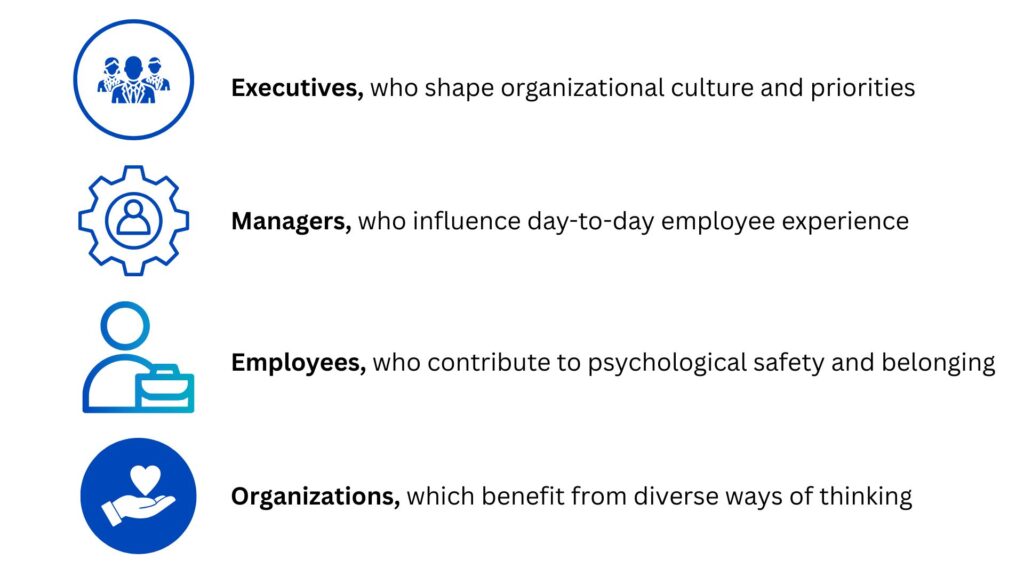
When workplaces adopt clearer communication, flexible structures, and inclusive leadership practices, they improve collaboration and trust across teams. This supports autistic and neurotypical staff, at all levels within the organization.
Research consistently shows that employees who feel a strong sense of belonging demonstrate greater resilience, professional growth, and engagement. Conversely, environments that unintentionally exclude or overlook neurodivergent communication styles can experience higher burnout, disengagement, and turnover.
Autism Inclusion as a Business Advantage
Understanding autism is not only an inclusion strategy, but also a performance strategy.
Emerging research suggests that autistic individuals may contribute unique advantages to organizational decision-making. A 2023 study found that autistic employees may be less influenced by the bystander effect, meaning they are more likely to notice problems, speak up about inefficiencies, or challenge groupthink when others may remain silent (Hartman et al., 2023).
In workplaces that encourage psychological safety and value diverse perspectives, this can translate into stronger risk management, improved innovation, and more ethical decision-making. These qualities are especially valuable in industries navigating rapid change, labor shortages, and increased customer expectations.
When autistic employees are supported rather than pressured to conform, organizations gain access to an untapped talent pool. This can ultimately lead to having a workforce that encompasses focus, honesty, pattern recognition, and consistency.
Looking Ahead to 2026
As organizations look ahead, leaders at every level must rethink how inclusion, communication, and performance intersect. Autism inclusion is not about adding complexity, but is instead about designing workplaces that work better for everyone.
This includes:
- Moving away from rigid, one-size-fits-all workplace norms
- Recognizing that productivity and professionalism can look different across individuals
- Investing in education and leadership development that reflects today’s workforce
- Embedding flexibility and clarity into systems, not just accommodations
As mentioned, research shows that when leaders understand neurodivergent experiences and proactively design inclusive systems, employees are more likely to stay, grow, and contribute meaningfully. This directly impacts retention and ROI, which are outcomes that matter across every department and industry.
How U Can Employ Supports Autism Inclusive Workplaces in 2026
U Can Employ™ (UCE), powered by Els for Autism Foundation®, partners with organizations to translate autism research and best practices into real-world workplace solutions. Rather than asking employers to become autism experts, UCE helps leaders understand how autism shows up in professional environments. The UCE team can show organizations how thoughtful adjustments can improve outcomes across recruiting, onboarding, management, and retention.
Through expert consultancy, workplace assessments, policy reviews, and tailored training, UCE supports companies in building autism inclusive environments that strengthen belonging, performance, and culture. This proactive approach helps organizations plan, budget, and lead with intention – ensuring inclusion is embedded, not reactive.
As research continues to evolve and the workforce becomes increasingly neurodiverse, organizations that invest in understanding autism today will be better prepared for the future of work.
Contact us at ucanemploy@elsforautism.org or schedule a free information session at https://calendly.com/katie-cappelen-elsforautism/30min.
References:
Autism Science Foundation. (2025). 2025 Year in Review. Autism Science Foundation. https://autismsciencefoundation.org/2025-year-in-review/
Hartman, L. M., Farahani, M., Moore, A., Rabbani, A., & Hartman, B. L. (2023). Organizational benefits of neurodiversity: Preliminary findings on autism and the bystander effect. Autism research : official journal of the International Society for Autism Research, 16(10), 1989–2001. https://doi.org/10.1002/aur.3012
Koldas, M., Dounavi, K., MacCarthaigh, M. et al. Facilitators and Barriers to Employment of Neurodivergent Individuals: A Systematic Literature Review of Employee and Employer Experiences. J Autism Dev Disord (2025). https://doi.org/10.1007/s10803-025-07139-6
National Autistic Society. (2025). Masking. https://www.autism.org.uk/advice-and-guidance/topics/behaviour/masking