
World Autism Month: Every 1 Matters on a Spectrum Without a Single Story
26 April 2026
Filed under: Blog
World Autism Month has traditionally focused on awareness and recognizing that autism spectrum disorder (ASD) exists. While awareness remains important, research and lived experience increasingly emphasize that autism cannot be understood through recognition alone. ASD is characterized by profound inter‑individual variability, making generalized narratives insufficient and often misleading (Cruz Puerto & Sandín Vázquez, 2024).
Autism spectrum disorder (ASD) is a neurodevelopmental disorder characterized by deficits in social communication and the presence of restricted interests and repetitive behaviors (Hodges, 2020).No two autistic individuals are the same, even when diagnostic labels appear similar.
This reality underscores the message of World Autism Month:
Every autistic individual experiences the spectrum differently – and every 1 matters.
The Autism Spectrum Is Not Linear
Autism is often mistakenly framed as a straight line – ranging from “less autistic” to “more autistic.” The autism spectrum does not function this way. It is not linear, and it cannot be captured by a single scale of severity or ability.
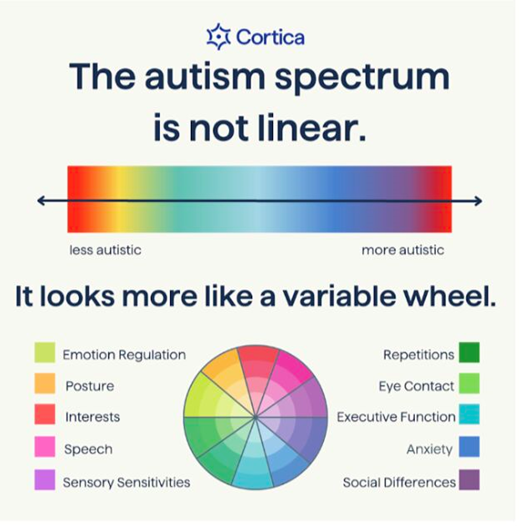
Instead, autism is better understood as a multi‑dimensional profile, where traits vary independently across individuals. One person may communicate fluently but experience intense sensory sensitivities. Another may be minimally verbal yet demonstrate strong emotional awareness or deep expertise in specific interests. Differences in social communication, anxiety, executive functioning, emotional regulation, sensory processing, and repetitive behaviors can each present at varying intensities, independent of one another (Cruz Puerto & Sandín Vázquez, 2024).
The spectrum functions less like a line and more like a variable wheel, with each dimension turning differently for each individual. No single trait defines autism, and no two autistic people share the same configuration of strengths and challenges.
This understanding helps explain why functioning labels fail and why assumptions are so often inaccurate. An autistic individual may require significant support in one area while functioning independently – or even excelling – in another. These differences are not contradictions but defining characteristics of autism itself.
What This Means for Employment and Customer Experience
Understanding autism as a non‑linear, individualized spectrum has direct implications for how organizations design workplaces and serve their customers. In employment contexts, autism is increasingly described in terms of support needs rather than fixed categories, acknowledging that abilities and challenges vary across domains and shift depending on environment, role expectations, and available supports.
In practice, this means two autistic employees or customers may require entirely different forms of access, communication, or accommodation. One individual may excel at structured, detail‑oriented tasks yet need clear written instructions and predictable schedules. Another may navigate complex interpersonal situations effectively but struggle with sensory overload, rapid transitions, or unspoken expectations. These variations are not contradictions but different outcomes of being on a varying spectrum (Cruz Puerto & Sandín Vázquez, 2024).
For employers, recognizing this variability challenges outdated assumptions about who can succeed at work and how performance should be evaluated. Research shows that autistic participation and retention are strongly influenced by environmental fit such as clarity of communication, flexibility in task execution, and supportive supervision, rather than where that individual lies on the autism spectrum. (Gupta & Aman, 2025; Liñares‑de‑Marcos et al., 2026).
The same principles apply to customer experience. As autistic individuals and families increasingly intersect with businesses as consumers, organizations that design environments, services, and communication with sensory, cognitive, and social differences in mind become more accessible to everyone. Inclusive practices like clear signage, predictable processes, flexible communication options, and staff education benefit autistic customers across the spectrum while also improving overall service quality.
When employers and service providers move beyond assumptions and respond to individuals as individuals, inclusion becomes practical rather than symbolic. In both employment and customer engagement, success is driven not by minimizing difference, but by designing systems that can adapt to it.
As research and lived experience affirm:
– Dr. Stephen Shore
if you’ve met one person with autism, you’ve met one person with autism.

Moving Beyond Awareness to Acceptance and Inclusion
The growing shift from autism “awareness” to “acceptance” reflects a deeper understanding: awareness without action leaves barriers intact. Acceptance requires meaningful change – adjusting systems, communication practices, and expectations to support autistic individuals as they are, rather than expecting conformity to neurotypical norms (Gupta & Aman, 2025).
Neurodiversity‑affirming research emphasizes that environmental fit, individualized support, autonomy, and predictable systems are central to positive outcomes for autistic people across the full spectrum of support needs (Liñares‑de‑Marcos et al., 2026).
This is where understanding must translate into practice.
How U Can Employ Turns Understanding into Action
U Can Employ™ (UCE), powered by Els for Autism®, helps organizations move beyond symbolic awareness and toward sustainable, individualized autism inclusion.
Grounded in evidence‑based principles and real‑world application, UCE supports organizations through:
- Training and education that reflect the full breadth of the autism spectrum, helping teams move past stereotypes and build practical, respectful communication strategies.
- Learning on-the-go through eCourses that increase understanding across entire organizations while reinforcing that autism inclusion is adaptive and individualized rather than a “checklist” item.
- Consultancy services that examine job design, workflows, and communication norms to better align individual strengths with operational needs
- HR policy and document reviews that embed inclusion into hiring, onboarding, performance management, and accommodation processes, reducing structural barriers that disproportionately impact autistic individuals.
Research shows that when systems adapt, inclusion improves not only outcomes for autistic individuals but also organizational clarity, consistency, and effectiveness (Liñares‑de‑Marcos et al., 2026).
Every 1 Matters – During World Autism Month and Beyond
World Autism Month is more than a moment of recognition; it is a call to sustained action. Celebrating autism means rejecting single narratives and embracing the reality that autism is complex, variable, and deeply individual.
Autism does not look one way. Inclusion cannot either.
When the spectrum is understood as a variable constellation rather than a linear scale, one truth becomes clear: honoring autism means honoring the individual—because every 1 matters.
References
Cruz Puerto, M., & Sandín Vázquez, M. (2024). Understanding heterogeneity within autism spectrum disorder: A scoping review. Advances in Autism, 10(4), 314–322. https://doi.org/10.1108/AIA-12-2023-0072
Gupta, A., & Aman, N. (2025). Embracing neurodiversity: The critical role of awareness and acceptance in autism spectrum disorders. Archives of Molecular Biology and Genetics, 4(1), 1–8.
Hodges, H., Fealko, C., & Soares, N. (2020). Autism spectrum disorder: definition, epidemiology, causes, and clinical evaluation. Translational pediatrics, 9(Suppl 1), S55–S65. https://doi.org/10.21037/tp.2019.09.09
Liñares‑de‑Marcos, J., Palomero‑Sierra, B., Sánchez‑Gómez, V., Fernández‑Álvarez, C. J., & Canal‑Bedia, R. (2026). An integrative approach between neurodiversity perspectives and quality‑of‑life models for autistic people across the spectrum of support needs. Frontiers in Psychiatry, 16, Article 1756323. https://doi.org/10.3389/fpsyt.2025.1756323