
Mental Health Matters: Why Supporting Autism at Work Supports Everyone
29 May 2026
Filed under: Blog
By Katie Cappelen, U Can Employ Project Manager
May 29, 2026
May was Mental Health Awareness Month, offering organizations an opportunity to reflect more intentionally and to ask deeper, more challenging questions about how they support the people they employ. The month forced us to look beyond awareness and consider how the way we design work may be contributing to the very challenges we are trying to solve. Because the reality is, mental health in today’s workforce is not an isolated issue.
Globally, an estimated 15% of working-age adults are living with a mental health condition, and depression and anxiety alone account for 12 billion lost workdays each year.
World Health Organization, 2024
Numbers like these are often shared to emphasize scale, but they also point to something deeper – work itself plays a meaningful role in shaping mental health. When expectations are unclear, workloads are high and support can be inconsistent. These conditions do not just affect productivity, but also affect people’s ability to sustain their work over time.
Looking Differently at Autism and Mental Health
Autism is frequently discussed alongside co-occurring conditions such as anxiety, depression, or ADHD. A large analysis published in The Lancet Psychiatry found that about 20% of autistic individuals experience anxiety disorders, 11% experience depression, and 28% have ADHD (Lai et al., 2019).
Though these numbers matter on their own, it is more important to recognize how we interpret them. These numbers are often framed in ways that suggest additional complexity for employers and hurdles that may come with hiring an adult with autism or related disabilities. However, they tell us something much more actionable by highlighting how strong an environment shapes the experience of those employed at a company.
Autistic individuals are more likely to experience mental health challenges in settings that rely heavily on unspoken expectations, constant social navigation, or inconsistent communication (Lai et al., 2019). Simple adjustments in how employers approach these topics can not only ease mental health challenges but also strengthen communication between autistic employees and their supervisors. These changes are often small, low-cost, and can lead to meaningful improvements across the entire workforce for all.
What the Workplace is Telling Us
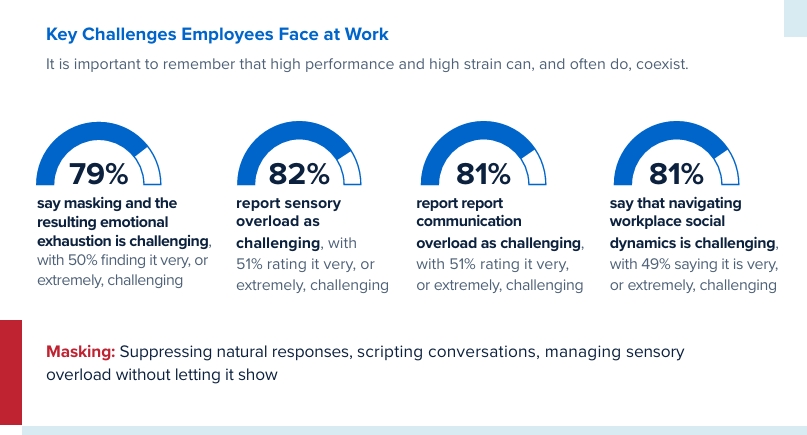
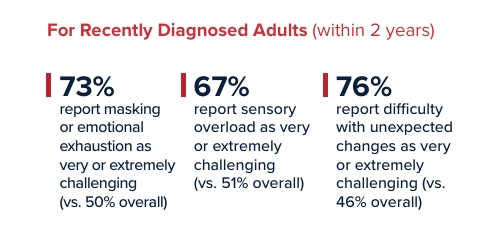
When looking at the Inside the Autistic Workforce survey recently conducted by NEXT for AUTISM, it is important to note that a large number of autistic employees surveyed report that they are working in roles that align with their strengths and that they are meaningfully using their skills. However, the same individuals admit that this result was not arrived at easily but instead took “years of trial, adaptation, and in many cases significant personal cost” (NEXT for AUTISM, 2026).
On top of relaying the path that they had to take to get to where they are, about half report regularly masking in order to meet those expectations. This detail matters, because masking is not simply an adjustment in behavior, but a sustained cognitive and emotional effort to blend in with perceived societal “norms”.
Source: NEXT for Autism – Inside the Autistic Workforce
More Than an Autism Conversation
What makes this important is that these experiences are not unique to autistic employees. What the survey makes clear for all employers and employees is something we see more broadly across workplaces; all employees are often performing well while quietly absorbing a level of strain that goes unrecognized.
The same workplace conditions that create strain here are the ones driving burnout more broadly. The World Health Organization identifies factors like lack of role clarity, limited autonomy, and insufficient support as key contributors to poor mental health at work (WHO, 2024).
These are not niche issues, but structural ones. When those conditions improve, the outcomes improve as well. Healthier workplaces are associated with stronger retention, better performance, and more sustainable engagement over time (WHO, 2024). This is where the connection becomes clear. Supporting autistic employees is not about creating something separate, but instead, about addressing the same underlying challenges that many employees are already navigating.

Extending the Lens to Caregivers
This perspective becomes even more important when we consider caregivers in the workforce that are responsible for individuals outside of themselves. Parents and caregivers of individuals with autism are balancing professional responsibilities alongside complex and often demanding care needs. Research shows that caregivers in this space experience significantly higher rates of mental health challenges, with one large analysis estimating that about 45% experience symptoms of depression globally (Lam et al., 2025). Other studies similarly place rates of both anxiety and depression among parents of children with autism at around 30% or higher (Mao, 2025).
Although many employees balance responsibilities outside of work that affect their mental health, it is important to consider those whose needs may be more significant and who may feel less comfortable discussing them with their employer due to communication differences.
Like the case with autistic employees, what they need is not entirely different. Clarity, flexibility, and supportive environments remain central to ensuring that these individuals know that they work for an inclusive employer who will take their unique needs into account.
A Different Way to think About Inclusion
This is where autism inclusion starts to look less like a specialized initiative and more like a strategic one. The same practices that reduce strain for autistic employees – clear expectations, consistent communication, thoughtful management, and flexibility in how work is done – are the ones that improve mental health outcomes across the board.
The NEXT for AUTISM survey reinforces this directly. The conditions that allow autistic employees to contribute more fully are the same ones that make workplaces more effective overall. This shifts the conversation for employers. It is no longer about whether organizations can support employees with mental health needs, disabilities, or autism, but whether they are willing to improve how work is structured and how expectations are communicated for everyone in order to create a sense of belonging for all.
Moving Forward
Mental Health Awareness Month offered a moment to step back, but also a chance to move forward with greater intention.
At U Can Employ™, our work focuses on helping organizations understand where their systems may be creating unnecessary strain and how those systems can be redesigned to better support both performance and wellbeing. For many teams, that begins with building a shared understanding of how mental health, autism, and other disabilities may show up at work and how they may all intersect. We offer services and consultancy that can help your business better practices and approaches to a variety of topics so that you can naturally become a more inclusive employer for all.
One service that may be a beneficial first step is taking our eCourse “How to Create a Psychologically Safe Workplace for All” which includes an overview of psychological safety, mental health, information on the positive impact of creating a safe work environment, and keys to doing so. You can find this course by visiting eCourses – U Can Employ.
Els for Autism also offers a wide variety of mental health services for those who may need to discuss how to promote optimum mental, emotional, and social health and well-being of individuals with autism and their families. These services can be conducted virtually or in-person. Please visit Mental Health Counseling Services – Els for Autism to learn more!
References
Lai M, Kassee C, Besney R et al. Prevalence of co-occurring mental health diagnoses in the autism population: a systematic review and meta-analysis. The Lancet Psychiatry, 2019; 6, 819-829. Prevalence of co-occurring mental health diagnoses in the autism population: a systematic review and meta-analysis – The Lancet Psychiatry.
Lam X, Cheng L, Leo C et al. Global prevalence of depression in caregivers of children with autism: A systematic review and meta-analysis. Journal of Pediatric Nursing: Nursing Care of Children and Families, 2024; 80, e74-e85. Journal of Pediatric Nursing – Export Citations.
Mao A. 3.4 Caregiver Stress in Parents of Children With ASD. Journal of the American Academy of Child & Adolescent Psychiatry, 63S6, 2024. 3.4 Caregiver Stress in Parents of Children With ASD – Journal of the American Academy of Child & Adolescent Psychiatry
NEXT for AUTISM. (2026). Inside the autistic workforce: A national survey of autistic employees on their workplace experience and what employers need to know. NEXT for AUTISM. NEXT_Inside-Autistic-Workforce_Brochure.DIGITAL (1).pdf
World Health Organization. (2024). Mental health at work. https://www.who.int/news-room/fact-sheets/detail/mental-health-at-work