
The Competitive Advantage Companies Aren’t Talking About: Preparing for a More Neurodiverse Workforce
21 July 2026
Filed under: Blog
By Katie Cappelen, U Can Employ™ Project Manager
Business leaders today are preparing for rapid change. Artificial intelligence, digital transformation, and evolving workforce expectations are reshaping how organizations operate, recruit talent, and serve customers. Yet alongside these trends, another workforce shift is emerging, and it has received comparatively little attention in business strategy discussions.
According to the Centers for Disease Control and Prevention (CDC), approximately 1 in 31 eight-year-old children in the United States has been identified with autism, a significant increase from 1 in 150 in 2000 (CDC, 2025). While this statistic is often discussed in healthcare and education, it should also be discussed in boardrooms. These children represent the next generation of employees, customers, managers, and entrepreneurs. As they enter adulthood, neurodiversity will become an increasingly common characteristic of the workforce and marketplace.
Neurodiversity Is a Workforce Strategy
Many organizations first think about autism when an employee requests an accommodation, or a manager encounters an unfamiliar situation. While these moments are important, they often lead to reactive decision-making rather than long-term planning.
Like technological advancement or demographic change, neurodiversity is a workforce trend that organizations should proactively prepare for. As more neurodivergent individuals enter the workforce, leaders will need to recruit, onboard, and develop employees with a broader range of communication styles, learning preferences, and problem-solving approaches. Preparing for this shift is not simply about compliance. It is about strengthening leadership, expanding access to talent, and building workplaces where employees can do their best work.
Preparing for the Future of Work
The World Economic Forum’s Future of Jobs Report 2025 identifies talent shortages, organizational culture, and skills gaps as some of the greatest barriers to business transformation. At the same time, artificial intelligence continues to redefine how work is performed, creating new opportunities for innovation and productivity. These trends are complimentary of one another, not competing priorities.
While organizations invest in technology, they must also prepare the people who will use it. Deloitte’s 2024 research on neuroinclusion suggests that organizations embracing diverse cognitive perspectives are often better equipped to innovate, solve complex problems, and adapt to change (Sniderman, et al., 2024). Preparing for the future of work therefore requires investment in both technology and people.
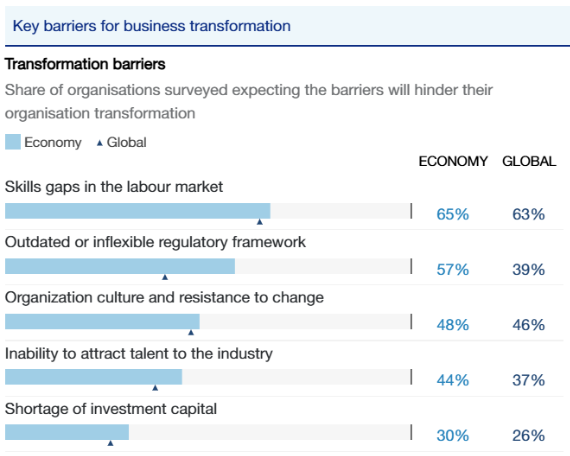
The World Economic Forum’s findings reinforce an important point: despite advances in technology, organizations continue to identify people-related challenges as their greatest barriers to transformation. These include skills gaps, organizational culture, outdated frameworks, and attracting talent.
This presents an opportunity to think differently.
As the workforce becomes increasingly neurodiverse, organizations that broaden their approach to talent acquisition, manager and staff education, and workplace inclusion may be better positioned to address these challenges while building stronger, more adaptable teams.
Autism Inclusivity Beyond Hiring
Neurodiversity is often discussed in the context of recruitment, but its impact extends far beyond hiring. Managers who understand neurodiversity are better equipped to communicate expectations clearly, provide consistent feedback, and support employees with varying work styles. Structured onboarding and clear communication improve not only the experience of autistic employees but also the effectiveness of entire teams.
The same principle applies to customers. As more autistic individuals enter adulthood with increasing purchasing power, organizations that create accessible customer experiences and educate frontline staff will be better positioned to build trust and long-term loyalty.
Research from Accenture and Disability:IN has also found that companies leading in disability inclusion often outperform their peers across several business measures (Accenture, 2023). While these findings are broader than autism specifically, they reinforce an important principle: organizations that intentionally build inclusive cultures often strengthen innovation, engagement, and long-term performance.
Looking Ahead
Business leaders cannot predict every change that will shape the future of work, but they can prepare for the trends already emerging.
Artificial intelligence will continue to transform business. Workforce demographics will continue to evolve. Organizations that invest in understanding both technological innovation and an increasingly neurodiverse workforce will be better positioned to attract talent, strengthen leadership, improve customer experiences, and remain competitive.
The competitive advantage companies aren’t talking about may not be found in a new technology or business model. It may be found in their willingness to prepare today for the workforce of tomorrow.
References
Accenture. (2023). Getting to equal 2023: The disability inclusion advantage. https://www.accenture.com/content/dam/accenture/final/accenture-com/document-2/Disability-Inclusion-Report-Business-Imperative.pdf
Centers for Disease Control and Prevention. (2025). Autism data and statistics. https://www.cdc.gov/autism/data-research/
Sniderman, B., Golden, D., Holdowsky, J. & Buckley, N. (2024, July 12). The neurodiversity advantage: How neuroinclusion can unleash innovation and create competitive edge. Deloitte Insights. https://www.deloitte.com/us/en/insights/topics/diversity-equity-inclusion/unleashing-innovation-with-neuroinclusion.html
World Economic Forum. (2025). The future of jobs report 2025. https://www.weforum.org/publications/the-future-of-jobs-report-2025/